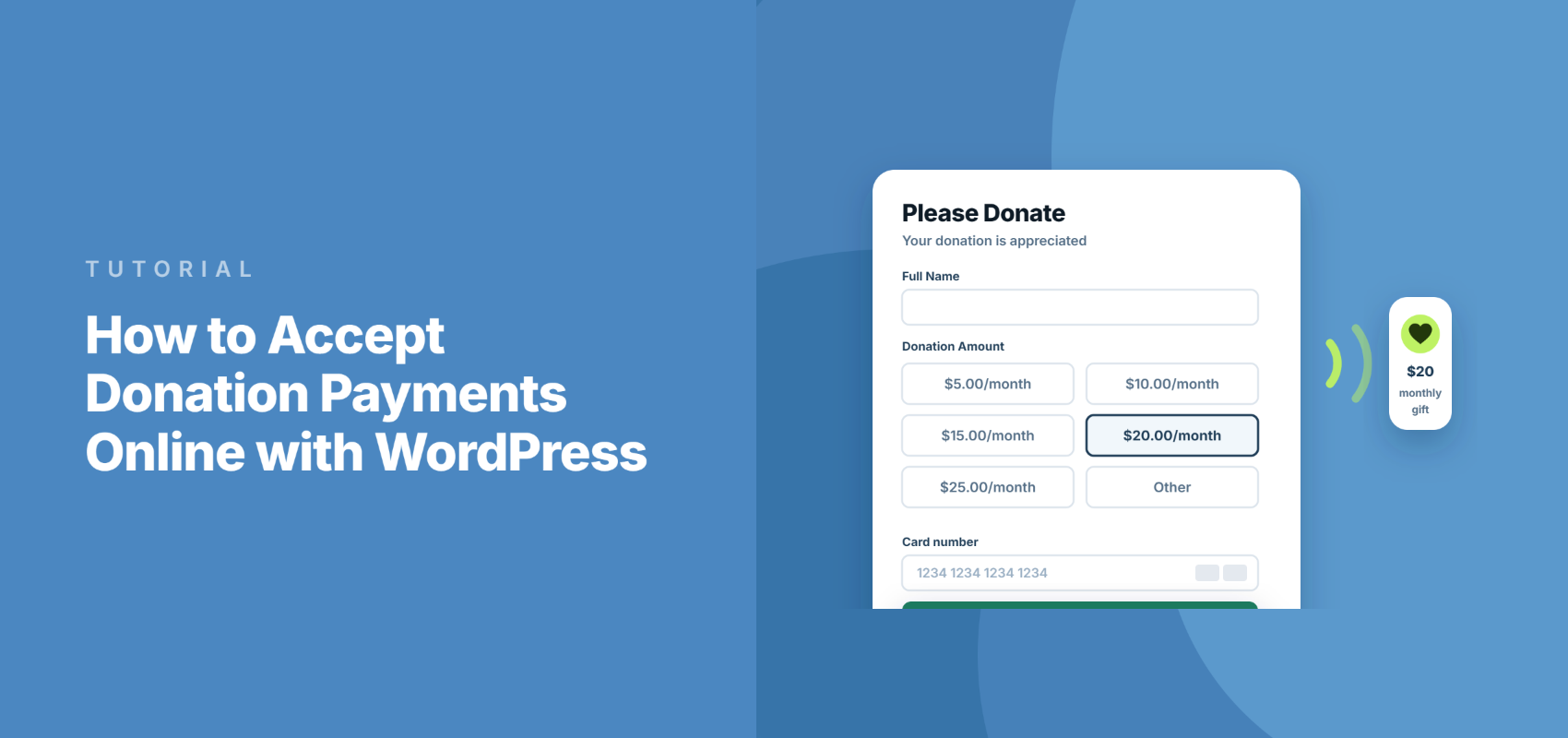
How to Accept Donation Payments Online with WordPress
Last updated on

 Cristian Rossi
Being passionate about making a difference in your community or beyond is great, but only if your visitors can contribute to the cause with ease.
Whether you run an animal sanctuary, work to create sustainable communities, organize a church camp, or support orphans and foster kids, every big, beautiful endeavor needs the right resources to thrive.
This is where you can accept donation payments online from your own WordPress site in about fifteen minutes, with no fundraising platform skimming a percentage and no developer involved.
In this article, I’ll guide you through a few of the easiest and most effective ways to set up online donation payments for your WordPress website so you can focus on the cause that matters most to you.
What Kinds of Donation Forms Can You Build?
Before building anything, it helps to know which type of form you actually want, because it changes how you set up the amounts.
There are three common patterns. A one-time form takes a single gift, which suits emergency appeals. A recurring form charges monthly, which suits sponsorship programs.
And a hybrid form offers a single donation amount that the donor can optionally make monthly, which is usually the highest-earning of the three.
For example, for an animal recovery fund, the hybrid pattern is usually the one to pick. Most of those donors arrive from a single emergency appeal and won’t come back later to start a monthly gift, so the checkbox catches them while they’re still deciding.
That said, let’s look at how you can accept online donations in WordPress.
The Best Solution for Accepting Online Donations
If you need to accept donations easily and securely online with credit cards, the best solution is WP Simple Pay, the #1 Stripe payments plugin for WordPress.
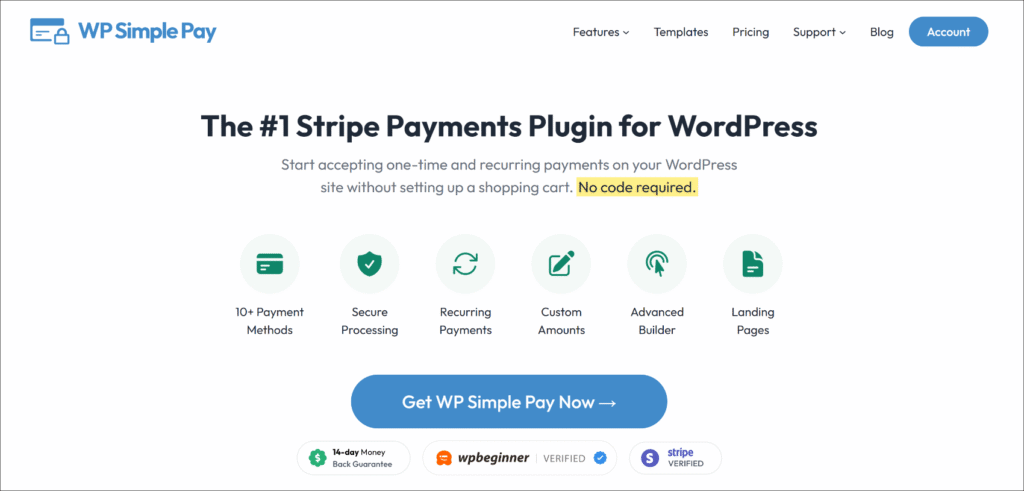
The plugin allows you to accept one-time or recurring donation payments directly on your website without having to write a single line of code or set up a complicated shopping cart.
WP Simple Pay also offers several pre-built payment form templates and a drag-and-drop form builder that allows you to get a donation form up and running on your site in just minutes.
Additional features of WP Simple Pay include:
- Custom Form Fields: Collect additional information along with the donation from your donors.
- Maximum Donation Amounts: Ensure that you stay within regulatory donation limits.
- Form Scheduling: Control when donation payments are accepted by setting up a start and end date.
- Weekly Summary Reports: Keep track of how your payment forms are performing with weekly summary reports sent straight to your inbox.
- Multiple Payment Methods: Collect more donations by offering 10+ payment methods, including Cash App, Apple Pay / Google Pay, ACH Direct Debit, Alipay, and more.
Step 1: Install and Activate WP Simple Pay
To start, head to the WP Simple Pay pricing page, pick a plan, and create your account.
Once you’ve signed up for a new account, you can download the plugin ZIP from your account area or your purchase receipt email. Then, in your WordPress admin, go ahead and upload the plugin to install and activate it.
After activation, the setup wizard opens on its own, which is a sign it installed cleanly.
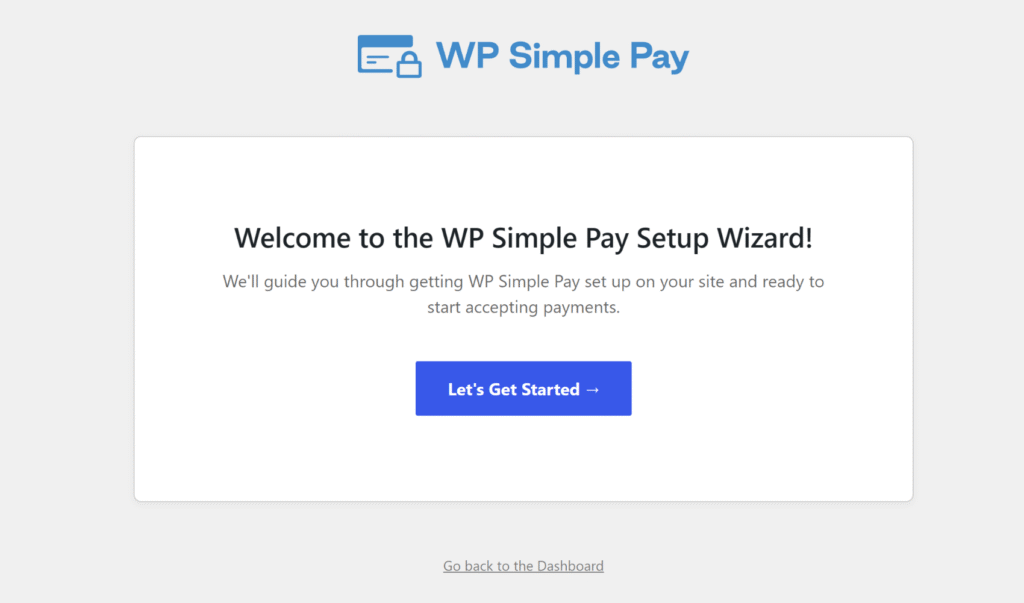
If the wizard didn’t appear, you can launch it from WP Simple Pay » Settings » Advanced using the Launch Setup Wizard button. There’s also a full install walkthrough in the docs if you get stuck.
Step 2: Connect WordPress to Stripe
Next, you’ll link the plugin to Stripe so the money has somewhere to land. Click Connect with Stripe and enter the email address on your Stripe account.
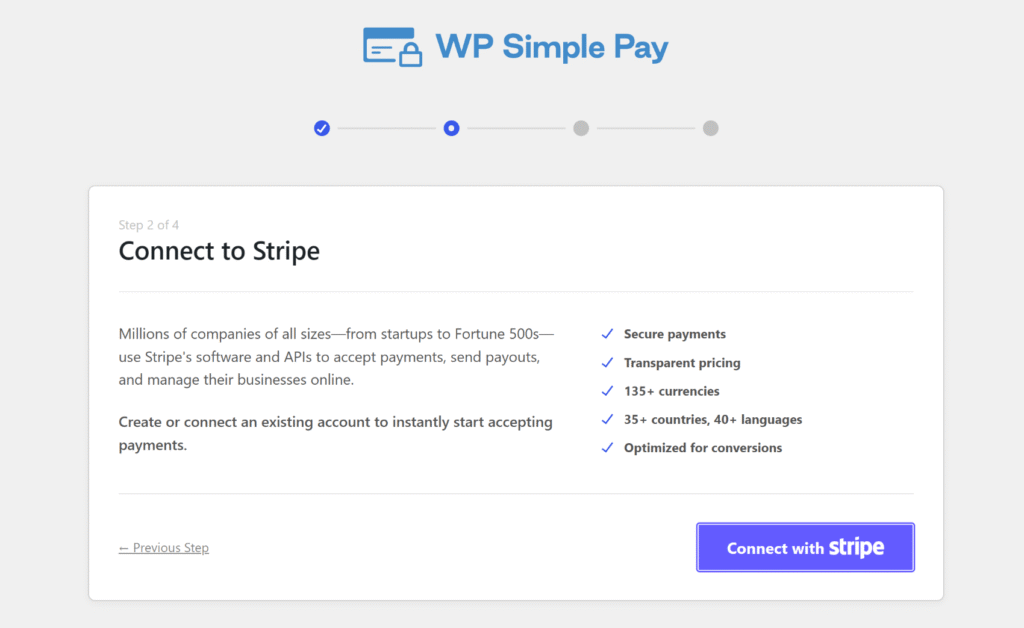
If you don’t have a Stripe account yet, you can create one from that same screen. And if you’re a registered nonprofit, it’s worth applying for Stripe’s discounted rate before you go live, since it covers donations specifically rather than product or ticket sales. The nonprofit fees documentation has the details.
Once the connection succeeds, you’ll land on a Setup Complete page.
Step 3: Pick a Donation Template
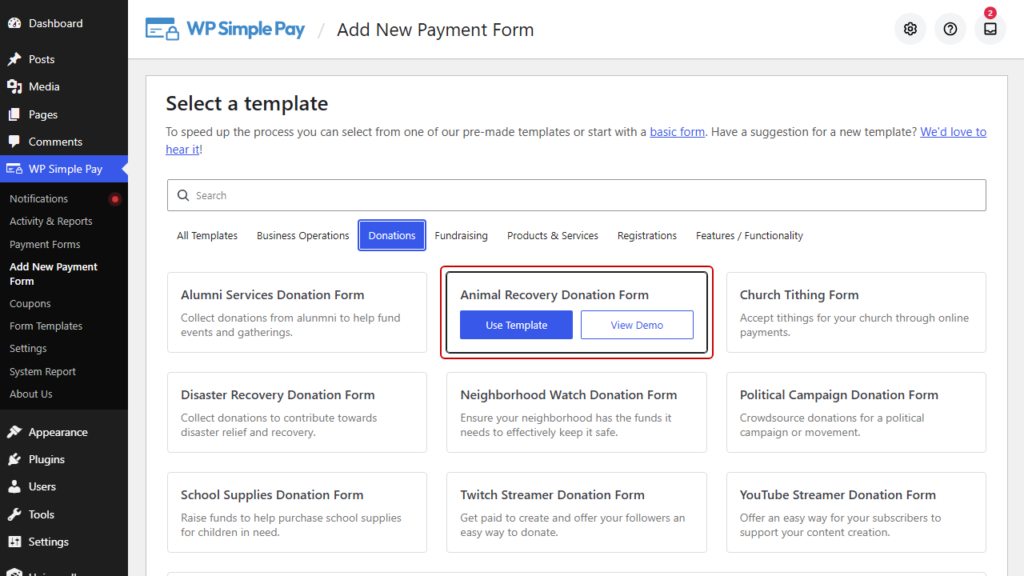
From here, go to WP Simple Pay » Add New Payment Form to open the template library. Filter it to the Donations category, and you’ll see the donation-specific starting points.
There are plenty to choose from depending on your cause, including Animal Recovery Donation Form, Disaster Relief Fundraising Form, Medical Expense Fundraising Form, Mission Trip Fundraising Form, and a plain Donate Button if you want something minimal.
For this example, pick the Animal Recovery Donation Form, since it arrives with the amount structure a donation page needs already in place.
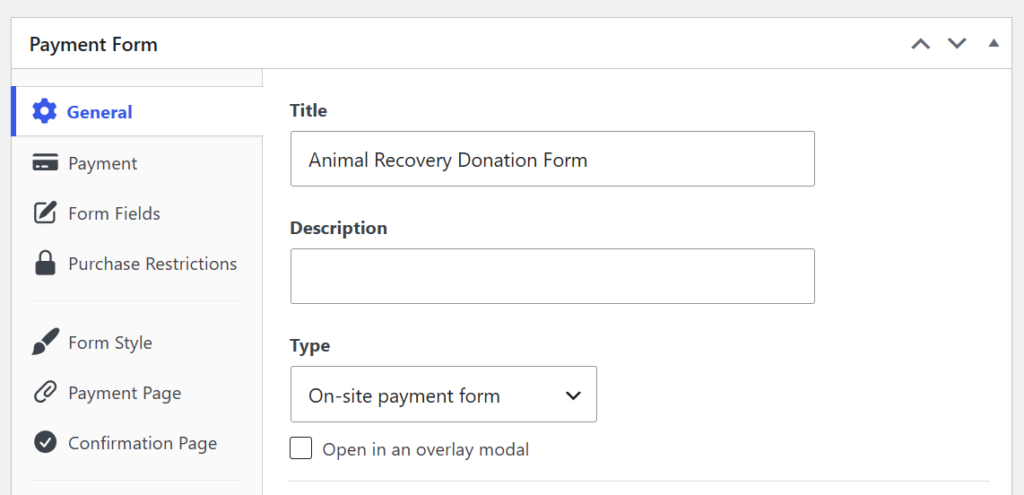
After picking a template, the General tab is where you set the form title and description, and choose the form type.
Select On-site payment form so donors can give without leaving your site.
Step 4: Set Your Donation Amounts
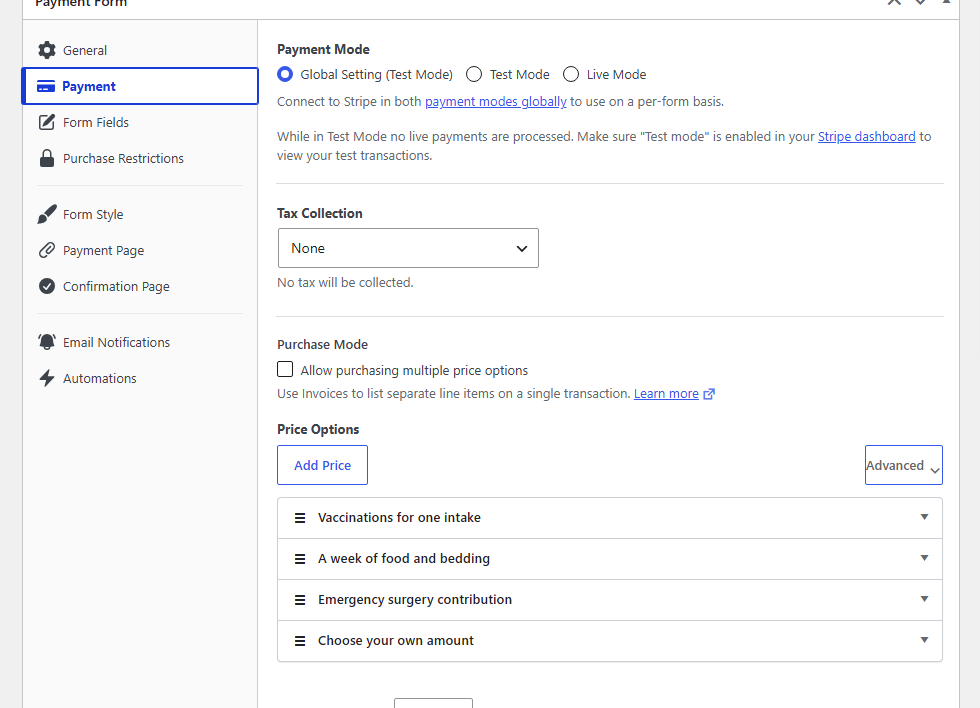
Now click through to the Payment tab. This is the part that decides how much you raise, so it’s worth slowing down here.
Use Add Price under Price Options to create each suggested amount. If your template already came with amounts, you can edit those instead of starting over.
Pro Tip: One checkbox to leave alone while you’re in here is: Allow purchasing multiple price options under Purchase Mode. It sounds like what you want for several donation tiers, but it isn’t. That setting lets a donor buy several options in a single transaction using Stripe Invoices, and switching it on quietly removes buy now, pay later methods from the form. For a pick-one donation form, leave it unticked.
Three tiers are usually enough, and each one lands better when it’s tied to something a donor can picture. For example, you can use donation amounts:
- $20 covers vaccinations for one intake. It’s the entry tier, so a first-time donor has somewhere comfortable to land.
- $45 covers a week of food and bedding, and it’s the one set as the default. That single choice does more work than the other two combined, because most donors accept the default rather than trading down.
- $120 covers an emergency surgery contribution. Few people pick it, but its presence makes $45 read as modest instead of generous.
To pre-select that middle tier, expand it and check Default Price. Only one price option can carry that flag, which is exactly why it’s worth thinking about which one gets it.
You should also let donors enter their own figure, because regular givers often have a number in mind that none of your tiers match. Add a price option and enable Allow amount to be determined by user, then set Minimum Amount and Maximum Amount to keep entries sensible.
That maximum is more useful than it sounds. If your organization has a regulatory cap on single gifts, this is where you enforce it rather than trusting donors to know.
Step 5: Offer Monthly Recurring Donations
Monthly giving is the difference between funding this month and funding next year, so this step is where the hybrid pattern comes together.
Staying in the Payment tab, expand the price option you want to make repeatable. Each option has a pair of buttons at the top, One time and Subscription, and which one you pick changes what the donor sees.
Subscription makes that amount monthly-only, which suits a sponsorship tier where recurring is the whole point. One time keeps it as a single gift, and that’s the setting to choose here, because it then unlocks the more interesting option underneath.
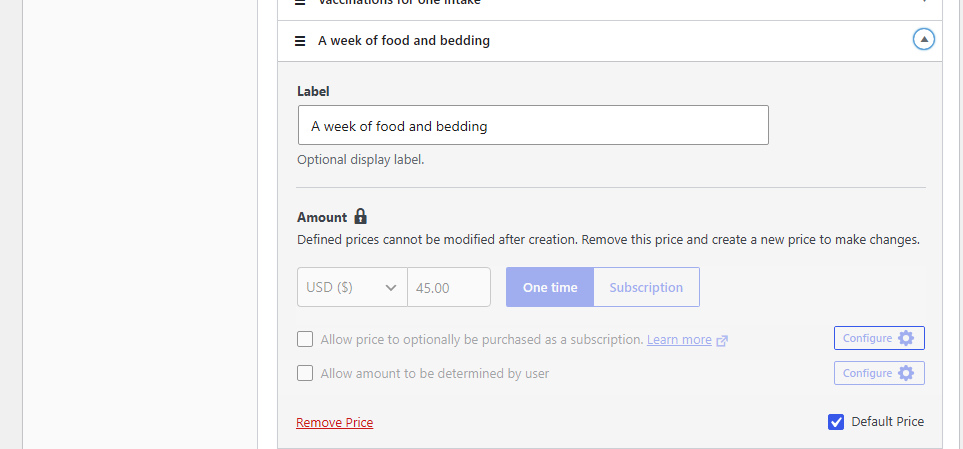
There are some optional steps you can perform to further customize the pricing details for your donation form.
With One time selected, tick Allow price to optionally be purchased as a subscription. That’s the checkbox that puts a “make this monthly” option on the form for the donor to choose.
Then click the Configure button beside it, which is where the actual settings live. Inside, you’ll find the “Optional Recurring Toggle” Label for the wording donors see, and wording like “Make this a monthly gift” keeps the ask explicit rather than buried. You can also set Recurring by Default, which flips it so monthly is already selected when the page loads and the donor opts out rather than in.
The same panel holds Billing Period and Billing Interval for the schedule, monthly being the usual choice for donations, plus a Free Trial and Setup Fee that neither fit donation forms particularly well.
One thing to get right the first time. Once a price has been created, its amount locks, and the builder tells you so: “Defined prices cannot be modified after creation. Remove this price and create a new price to make changes.” So decide the amount and the recurring behaviour before you save, because changing your mind later means removing the price and adding a fresh one.
If you’d rather let donors spread one large gift across several payments instead of giving indefinitely, the Installment Plan option does that, and there’s more in the guide on installment payment plans.
Step 6: Collect the Details You Actually Need
With amounts sorted, open the Form Fields tab. This is where you add the questions that make a donation useful rather than anonymous data.
You can add dropdowns, text fields, checkboxes, and more. For an animal recovery form, three are worth adding: a dropdown for which program the gift supports, a checkbox to join the newsletter, and a checkbox letting the donor stay anonymous in public thank-you posts.
That last one matters more than people expect. Some donors will only give if they can do so quietly, so removing that worry removes a reason not to donate.
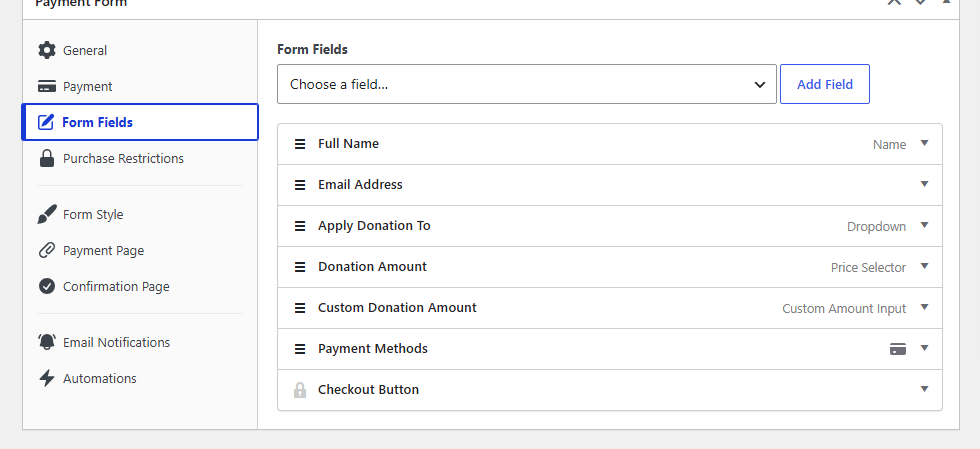
Keep the list short, though. Every extra field is another chance for someone to abandon the form, so ask for what you’ll genuinely use and nothing more. There’s more detail in the guide on adding custom fields.
Step 7: Publish and Embed Your Form
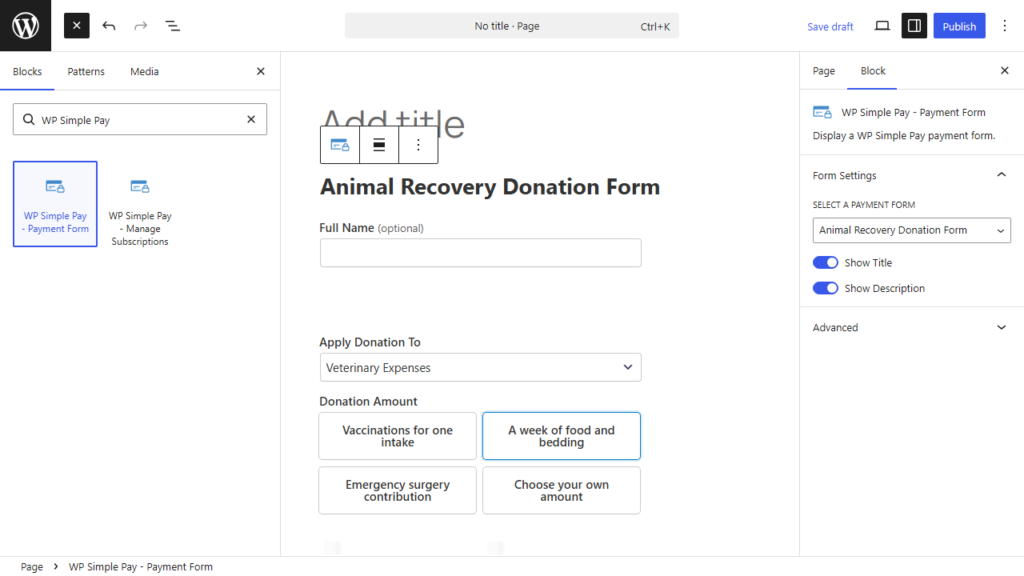
When the form looks right, click Publish. Then open the page or post where you want it to appear, click the + icon, search for the WP Simple Pay block, and add it.
Pick your new form from the block’s dropdown, publish the page, and you’re live.
Accepting Different Donations on WordPress
Now that you know how to create a donation form, you can set up different types of forms to support a cause. For example, here are different types of donation forms you can create.
1. Offering Monthly Recurring Donations
One of the best ways to get consistent donations is to allow donors to opt in to recurring monthly donations.
You can use WP Simple Pay and WordPress to implement recurring donation forms directly on your website effortlessly.
Below is an example of a monthly recurring donation form that offers multiple amounts:

You can also set up donation forms with the option to donate once or monthly, giving donors more flexibility.
Adding the checkbox is simple using WP Simple Pay’s form builder.

2. Creating Automatic Monthly Donation Forms
To create similar forms for your WordPress website, you can simply install and activate WP Simple Pay and get building.
Once you’re in the form builder, you can add your donation price options, toggle on One time and check the box to allow the price to optionally be purchased as a subscription.
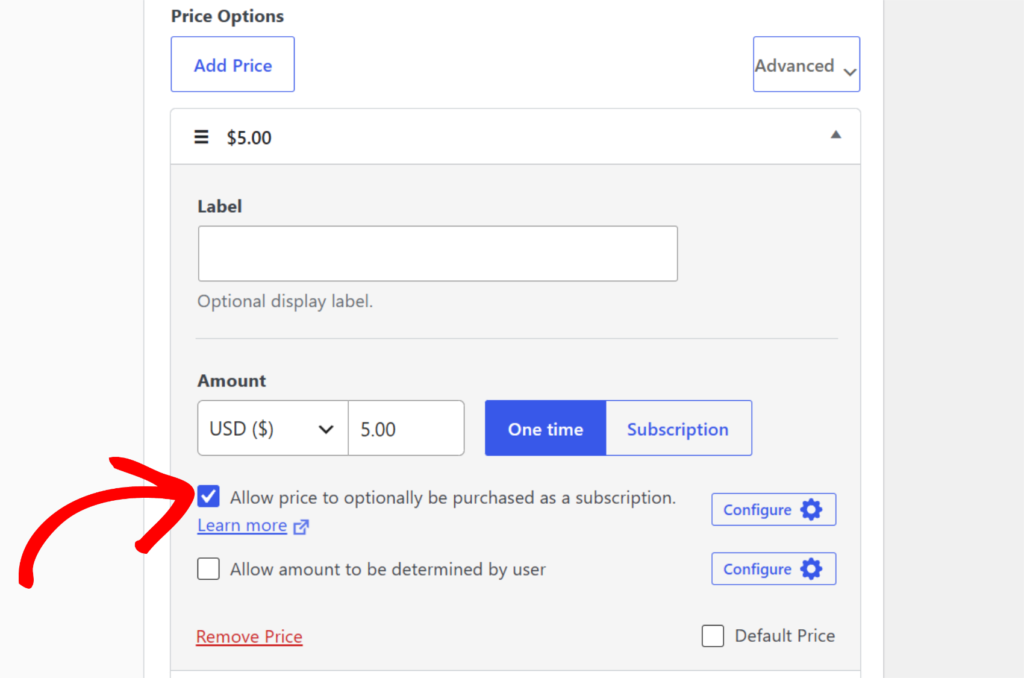
Or, you can require the price option to be set up as a monthly recurring donation by toggling on the Subscription option.
3. Creating Custom Donations with Dropdowns & Text Fields
WP Simple Pay also lets you customize your donation forms by adding dropdowns and text fields.
For example, you can use custom fields to collect more information from your donors. This can help encourage donors to sign up for your newsletter.
Allowing donors to remain anonymous is also helpful in some situations. You can easily add this option using custom form fields.

Frequently Asked Questions
1. How much should I suggest as a default donation amount?
Start with your current average gift and set the default slightly above it. Offer three tiers, pre-select the middle one using the Default Price setting, and tie each amount to something concrete it buys. Most donors accept the default, so setting it too low quietly caps your average gift.
2. Do recurring donations need separate receipts?
Yes. Each recurring charge generates its own per-transaction receipt, because each one is a separate payment. Donors also need an annual giving summary totalling everything they gave across the year, which is a different document from those individual receipts and the one most want at tax time.
3. Can donors choose their own donation amount?
Yes. Add a price option with “Allow amount to be determined by user” enabled, then set a Minimum Amount and Maximum Amount to keep entries sensible. The maximum is also how you enforce a regulatory cap on single gifts rather than relying on donors to know it.
4. Do I need a paid plan to accept recurring donations?
Yes. Recurring donations and multiple suggested amounts both require WP Simple Pay Pro, which is available in every paid plan rather than one specific tier. WP Simple Pay Lite supports a single price option only, so it cannot offer several donation tiers on one form.
5. Can I limit when my donation form accepts payments?
Yes. The Purchase Restrictions tab lets you set a start and end date, so a campaign form stops accepting gifts once the deadline passes. That’s useful for time-bound appeals where donations arriving late create reconciliation work.
Final Thoughts
The plugin setup is the quick part. What actually moves the number is the three decisions inside it: considered tiers with a sensible default, a monthly option that donors can see clearly, and only the form fields you’ll really use.
Once that’s running, you can start testing which suggested amounts work for your donors rather than guessing.
I hope this article helped you learn how to accept donation payments online in WordPress. You may also want to see our guides on suggested donation amounts and driving traffic to your donation forms.
Ready to start collecting? Get WP Simple Pay and build your donation form today.
Disclosure: Our content is reader-supported. This means if you click on some of our links, then we may earn a commission. We only recommend products that we believe will add value to our readers.