
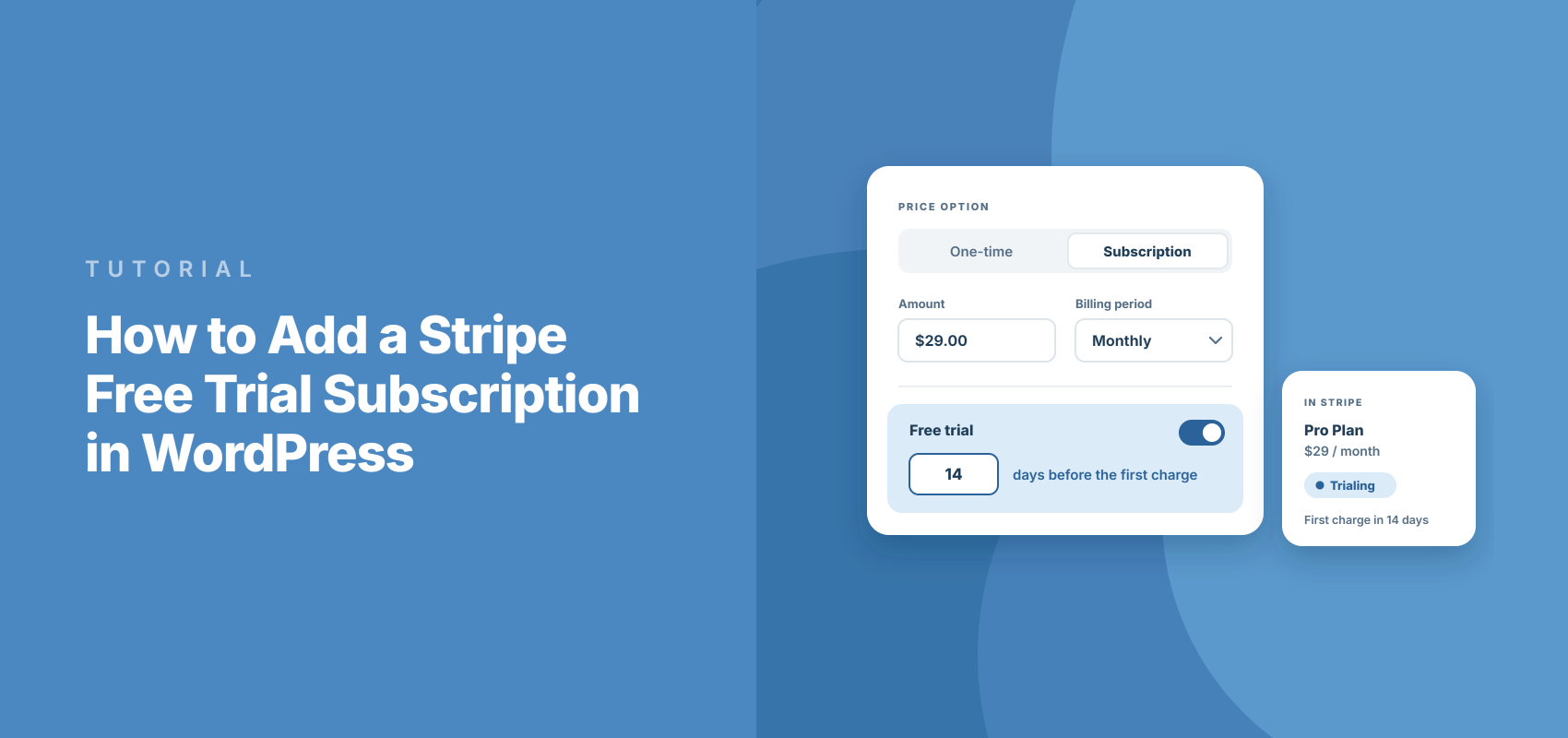
How to Add a Stripe Free Trial Subscription in WordPress
Last updated on

A free trial is one of the friendliest things you can offer a new customer. It says, “try it first, and pay once you’re sure,” and for a coaching program, a course membership, or a monthly service, that’s often what turns a curious visitor into a subscriber.
Setting up a Stripe free trial subscription in WordPress takes a handful of clicks with WP Simple Pay. You pick a template and type in how many free days you want. The plugin then saves the customer’s card at signup, charges nothing that day, and lets Stripe bill them automatically when the trial ends.
In this article, I’ll show you how to add a Stripe free trial subscription to your WordPress site, from picking the template to fast-forwarding a test signup past its trial so you can watch the first charge go through.
How Does a Stripe Free Trial Work in WP Simple Pay?
A free trial in WP Simple Pay is a normal Stripe subscription that starts with a set number of free days.
When a customer signs up, the plugin saves their payment method and charges nothing that day, unless the price also has a setup fee. When the trial ends, Stripe bills the saved card for the first period and keeps billing on your schedule after that.
Subscriptions also limit which payment methods appear. A subscription can only use payment methods that support repeat charges, so WP Simple Pay drops methods like Klarna, Afterpay, Affirm, iDEAL, and Pix from any subscription form.
The methods that stay are Card, ACH Direct Debit, SEPA Direct Debit, Bacs Direct Debit, Australia BECS Direct Debit, and Cash App. If a lot of your customers pay with buy now, pay later, a trial form won’t show them that option.
Why Use WP Simple Pay to Offer a Free Trial?
I use WP Simple Pay for trials, a Stripe payments plugin with more than 14,000 customers. Stripe runs the trial and the billing, so you don’t need a shopping cart, a membership plugin, or any code.
These are the parts that matter most for a free trial:
- A trial template that’s ready to go. It’s one of 89 form templates, and it comes with a 30-day trial already set.
- Stripe connects from the setup wizard. You sign in to Stripe once, and there are no API keys to copy.
- Trials, setup fees, and installment plans. All three advanced subscription options come with the Professional and Elite plans.
- Test mode built in. You can sign up with Stripe’s test cards before a real customer ever sees the form.
- No extra plugin fees on paid plans. Stripe’s standard processing fee still applies, but WP Simple Pay Pro doesn’t add a fee of its own.
Here’s how to build the trial form, starting with the plugin itself.
Step 1: Install and Activate WP Simple Pay
To offer a free trial, you’ll need the WP Simple Pay Professional or Elite plan. The Free Trial field is one of the advanced subscription features, so Lite and the Personal and Plus plans can sell subscriptions but not trials.
You’ll also need a Stripe account. If you don’t have one yet, you can create it during setup.
Your site needs HTTPS as well, since Stripe won’t process live payments without SSL. WP Simple Pay shows an admin notice if it’s missing.
Once you have your plan, go ahead and install and activate the plugin. If you’d like a walkthrough, here’s the WP Simple Pay installation guide.
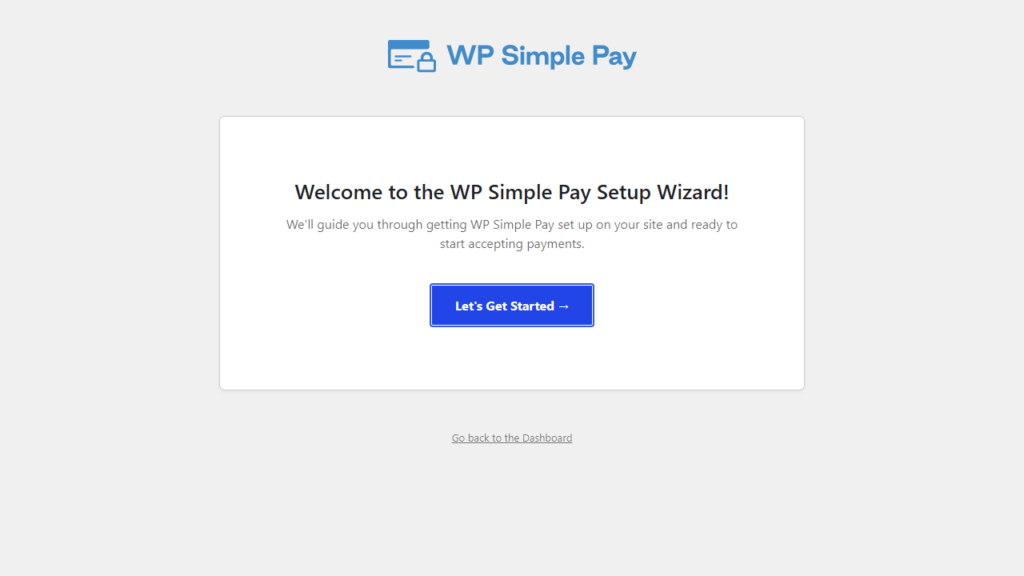
The setup wizard opens as soon as the plugin is active. When you click Let’s Get Started, it takes you through Activate Your License, Connect to Stripe, and Configure Emails.
Step 2: Connect WordPress to Stripe
Next, the wizard moves on to the Connect to Stripe step. Go ahead and click Connect with Stripe.
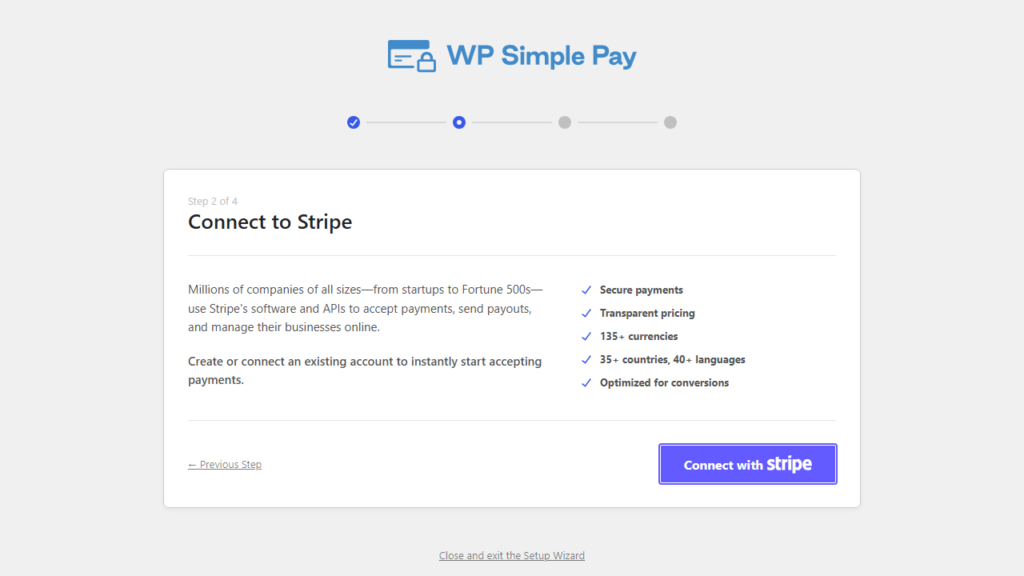
From there, sign in to Stripe, or create an account with your email address.
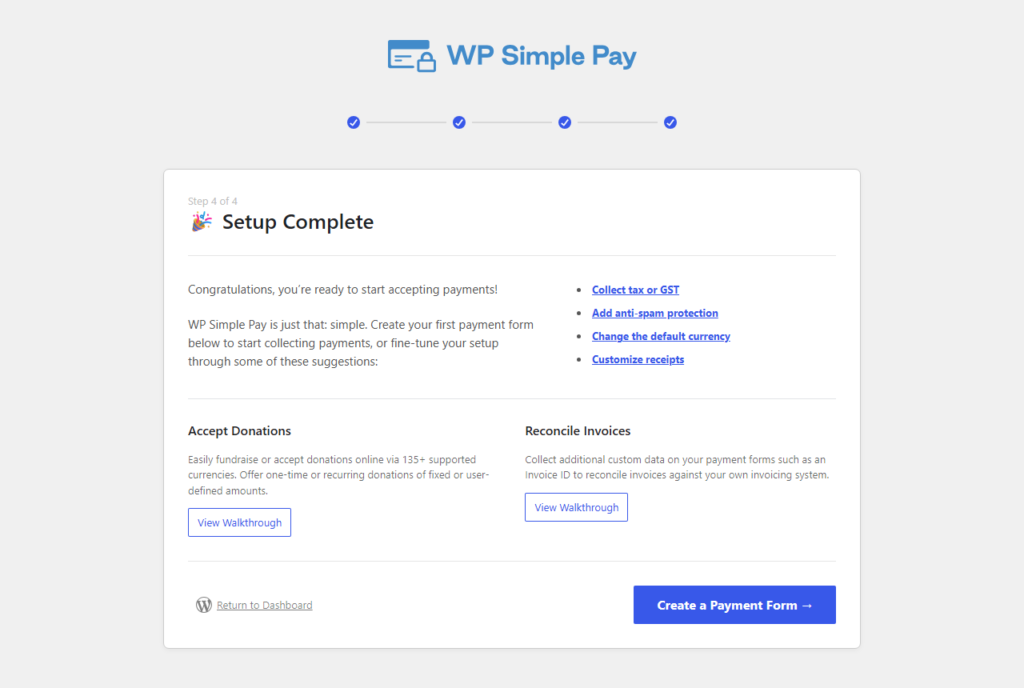
Once Stripe sends you back to WordPress, finish the email step. You’ll then land on the 🎉 Setup Complete screen.
Step 3: Start From the Trial Template
The quickest way to build a trial form is to start from the template that already has one. To get there, click Create a Payment Form on the last wizard screen.
You can also reach the templates any time from WP Simple Pay » Payment Forms and then click Add New Payment Form.
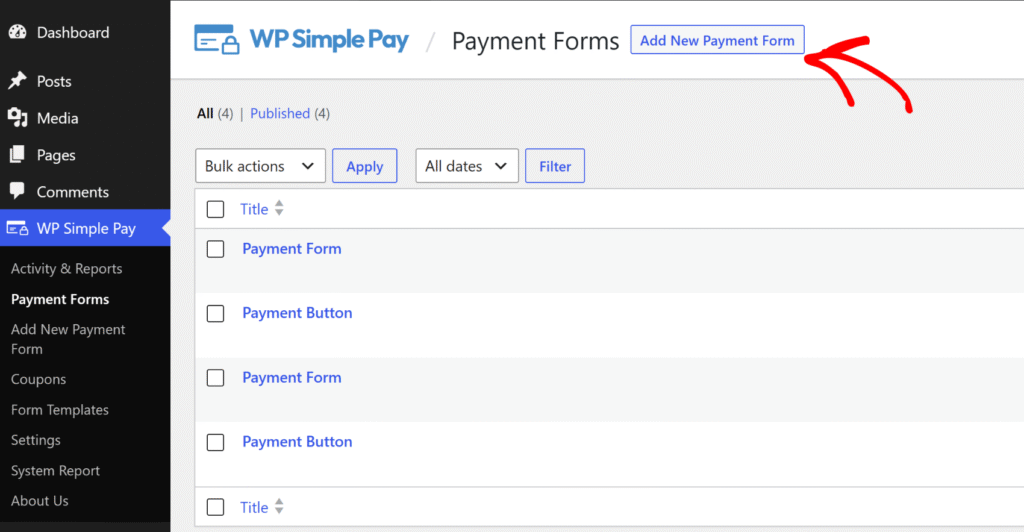
After that, type trial into the template search. The only match is Recurring Services with Trial Period Form, described as “Collect multiple payments after a set trial period.”
From there, hover over it and click Use Template.
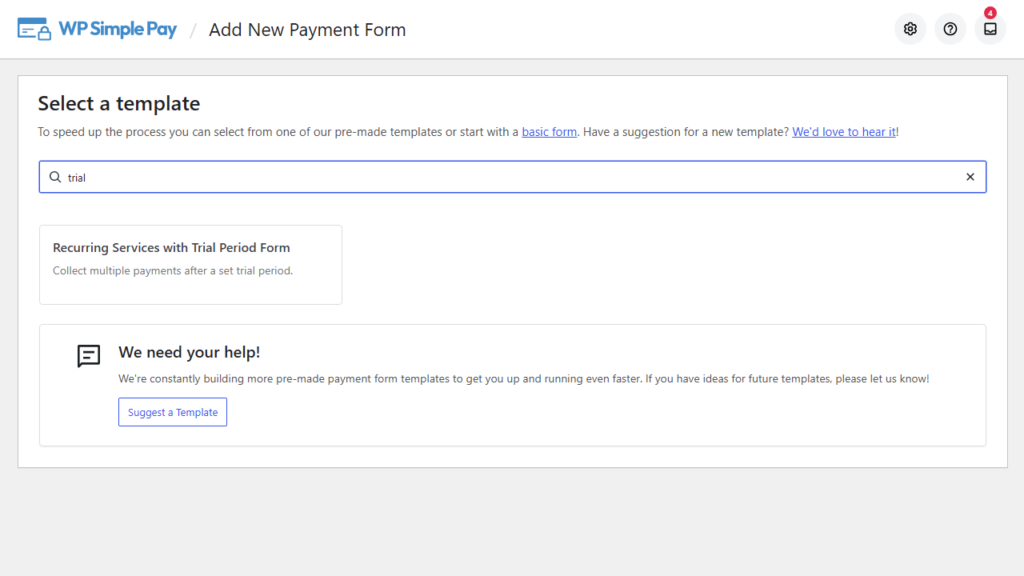
The template comes set up with a $25.00 monthly price, a 30-day free trial, and card payments. You’ll change all three to fit your service in the next steps.
Step 4: Say What Happens After the Trial on the General Tab
The General tab holds the form’s Title and Description, and this is where you tell customers what they’ll pay once the trial ends.
The template’s description only says “Try our service free for 30 days.” A single-price form doesn’t display the price anywhere else, so add it here, for example, “Try our service free for 30 days, then $25 a month. Cancel anytime.”
That one sentence means nobody is surprised when the first charge arrives.
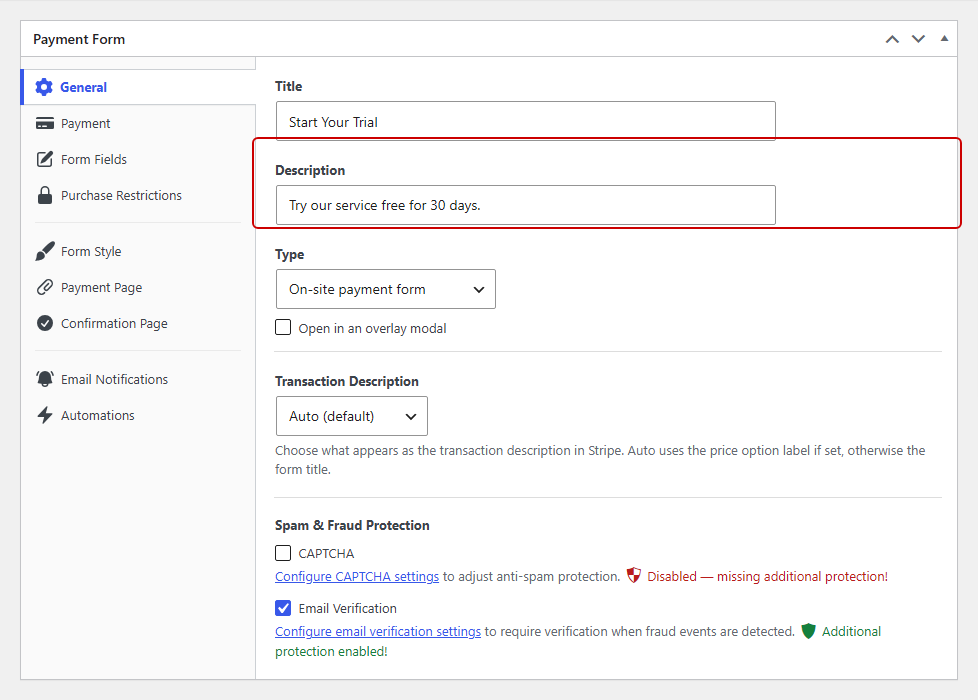
Further down, the Type setting decides where checkout happens. On-site payment form keeps checkout on your page, while Off-site Stripe Checkout form sends customers to a page hosted by Stripe.
Both types support free trials. If you’d rather show a button that opens the form in a popup, choose the on-site type and tick Open in an overlay modal.
Step 5: Set the Trial Length on the Payment Tab
Next, head over to the Payment tab, where you’ll set the price, the billing period, and the trial length.
On the price option, make sure Subscription is selected rather than One time.
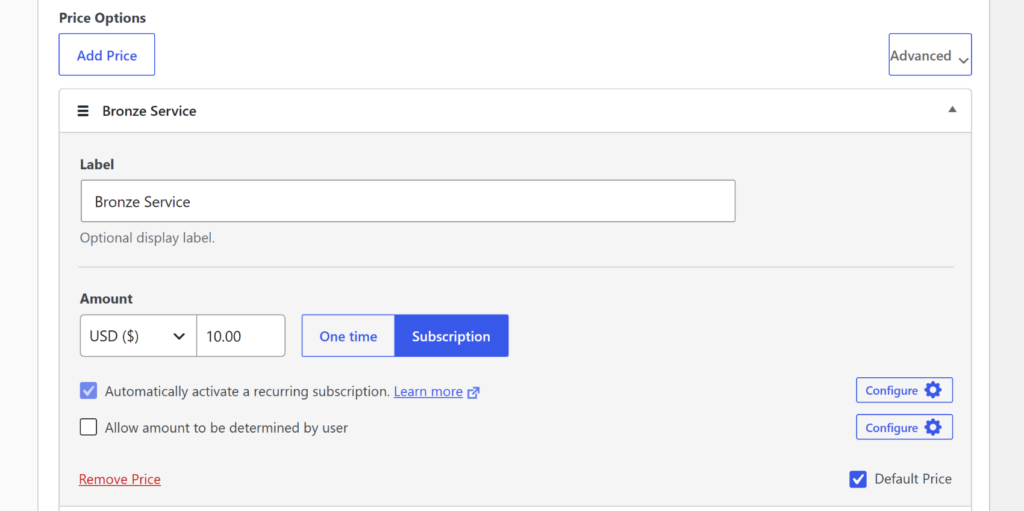
Then, click Configure to open the Recurring Settings dialog.
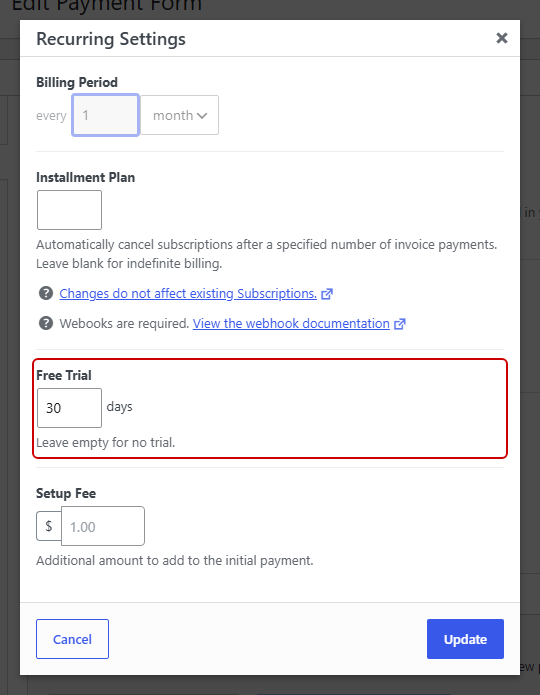
Inside, Billing Period sets how often the customer is charged after the trial, such as every 1 month.
After that, type the number of free days into Free Trial. If you leave it empty, the form has no trial.
If you charge an onboarding fee, Setup Fee adds it to the first payment. That fee is charged at signup even during the trial, so the customer won’t pay $0 on day one.
Once you’re done, click Update to close the dialog. The price option’s label then reads something like “30 day free trial then $25.00 every 1 month,” which is a quick way to check your work.
Before you save, double-check the amount, because a price can’t be edited after the form is created. To change it later, you remove that price and add a new one.
Step 6: Choose What Customers See After Signing Up
With the price saved, you can open the Confirmation Page tab. This decides where customers land after they start the trial.
Its Payment Success Page setting has four options: Dedicated Confirmation Page, Global Setting, Custom Page, and External URL.
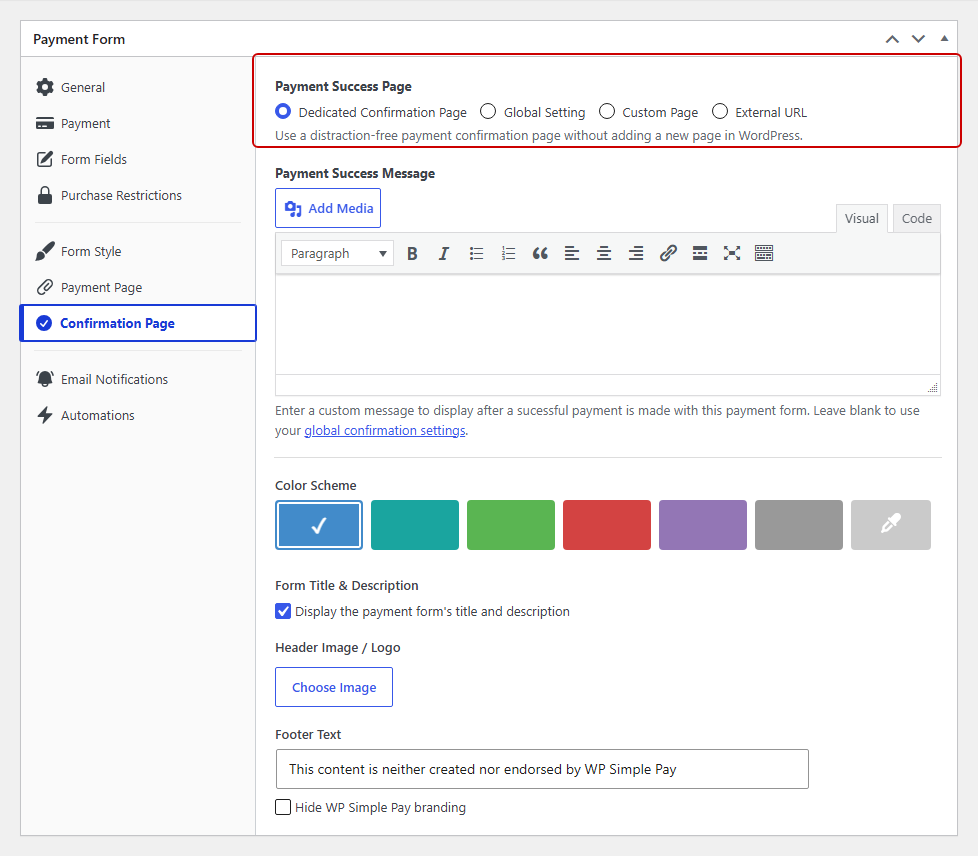
The default, Dedicated Confirmation Page, shows a distraction-free confirmation without adding a page to WordPress. If you leave its Payment Success Message blank, it uses the global message from WP Simple Pay.
That global message already tells the customer what they’ll be charged and when, using the {recurring-amount} and {next-invoice-date} smart tags.
This is also a good spot for a next step, like a link to book the first session or log in to the course.
Step 7: Turn On Stripe’s Trial Reminder Email
It’s a good idea to remind customers before their trial turns into a paid subscription. People who forget they signed up are the ones most likely to dispute that first charge.
WP Simple Pay doesn’t send this email itself, but Stripe can send it for you.
To turn it on, head to Settings » Billing » Subscriptions and emails in your Stripe Dashboard. Under Customer emails, switch on Send a reminder email 7 days before a trial ends, then save.
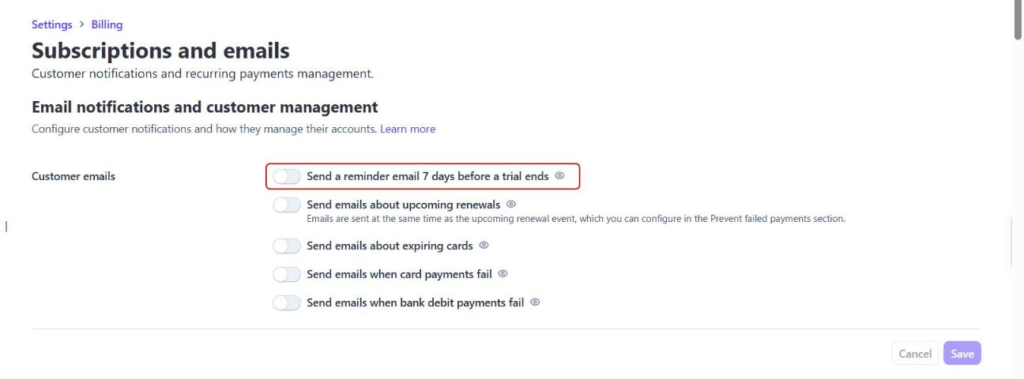
Stripe’s reminder includes a cancellation link and a link to update payment details. For more ways to turn trial signups into paying customers, see these tips for free trial offers that convert.
Step 8: Test the Trial, Then Fast-Forward It
Before you go live, it’s worth running one test signup. With Payment Mode still on Test Mode, open the form and pay with Stripe’s test card 4242 4242 4242 4242any future expiry date, and any CVC.
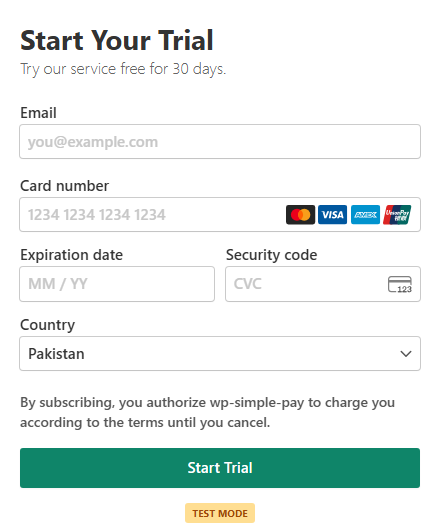
When you’re done, Finish simulation deletes the test customer and subscription from the sandbox, so use a throwaway signup for this. Here’s more on Stripe test mode in WordPress.
Step 9: Publish the Free Trial Form
Once the test looks right, you can add the form to a page. Open the page in the block editor and click the + icon.
Then, search for WP Simple Pay – Payment Form and add the block. After that, choose your trial form in the block’s settings.
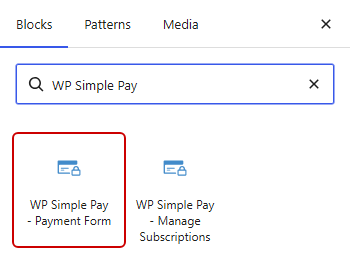
If your page builder doesn’t use blocks, the shortcode works too, for example, with your form’s ID. The payment form block guide covers both.
With the form on the page, switch Payment Mode to Live Mode under WP Simple Pay » Settings » Stripe » Account so real signups go through.
If you’d rather give the trial its own distraction-free page, here’s how to create a Stripe payments landing page in WordPress.
Common Free Trial Mistakes to Avoid
Most trial problems come from the same few setup choices.
- Leaving the price off the form. The template only mentions the free days, so customers can’t see the charge that follows unless you add it to the description.
- Forgetting the reminder. Without Stripe’s 7-day reminder, customers can forget they signed up, and surprised customers are more likely to dispute the first charge.
- Picking a trial longer than your value takes to show up. If customers see results in the first week, a 30-day trial only delays the first payment.
- Expecting buy now, pay later to work. Subscription forms drop Klarna, Afterpay, and Affirm, so don’t promise them on a trial page.
Once the trial is live, decide how customers can manage it. Here’s how to allow customers to manage subscriptions in WordPress.
Frequently Asked Questions
1. Which WP Simple Pay plan do I need to offer a free trial?
Free trials need the WP Simple Pay Professional or Elite plan. Lite and the Personal and Plus plans can sell subscriptions, but their Free Trial field stays locked. The trial template still loads on the Plus plan, so check your plan before you build the form.
2. What happens when a free trial ends?
Stripe charges the payment method the customer saved at signup for the first billing period, then keeps billing on the schedule you set. If you’ve turned on Stripe’s trial reminder, the customer gets an email 7 days before that first charge, with a link to cancel.
3. What happens if the first payment after a free trial fails?
Stripe retries a failed subscription payment on the schedule set on the Retries tab of its Revenue recovery page, with “8 tries within 2 weeks” as its recommended default. WP Simple Pay doesn’t send failed-payment emails, so turn on Stripe’s “Send emails when card payments fail” setting as well.
4. Can customers update their card or cancel during a free trial?
Customers can update their card or cancel once you turn on subscription management under WP Simple Pay » Settings » Subscription Management. You can choose On-site management or Stripe’s Customer Portal, and set cancellations to take effect immediately or at the end of the billing period.
5. Does a free trial work with Stripe Checkout?
Free trials work with both the on-site payment form and the off-site Stripe Checkout form. WP Simple Pay sends the same trial length to Stripe either way, so you can switch the form’s Type without rebuilding the trial.
Final Thoughts
A free trial form takes a few minutes in WP Simple Pay. Most of the work that makes it convert happens around the form: the price in the description, Stripe’s reminder email, and one test run before launch.
I hope this article helped you learn how to add a Stripe free trial subscription in WordPress. You may also want to see our guides on how to add a setup fee to a Stripe subscription in WordPress and how to customize and manage Stripe payment reports.
What are you waiting for? Get started with WP Simple Pay today!
To read more articles like this, follow us on X.
Disclosure: Our content is reader-supported. This means if you click on some of our links, then we may earn a commission. We only recommend products that we believe will add value to our readers.
Leave a Reply