
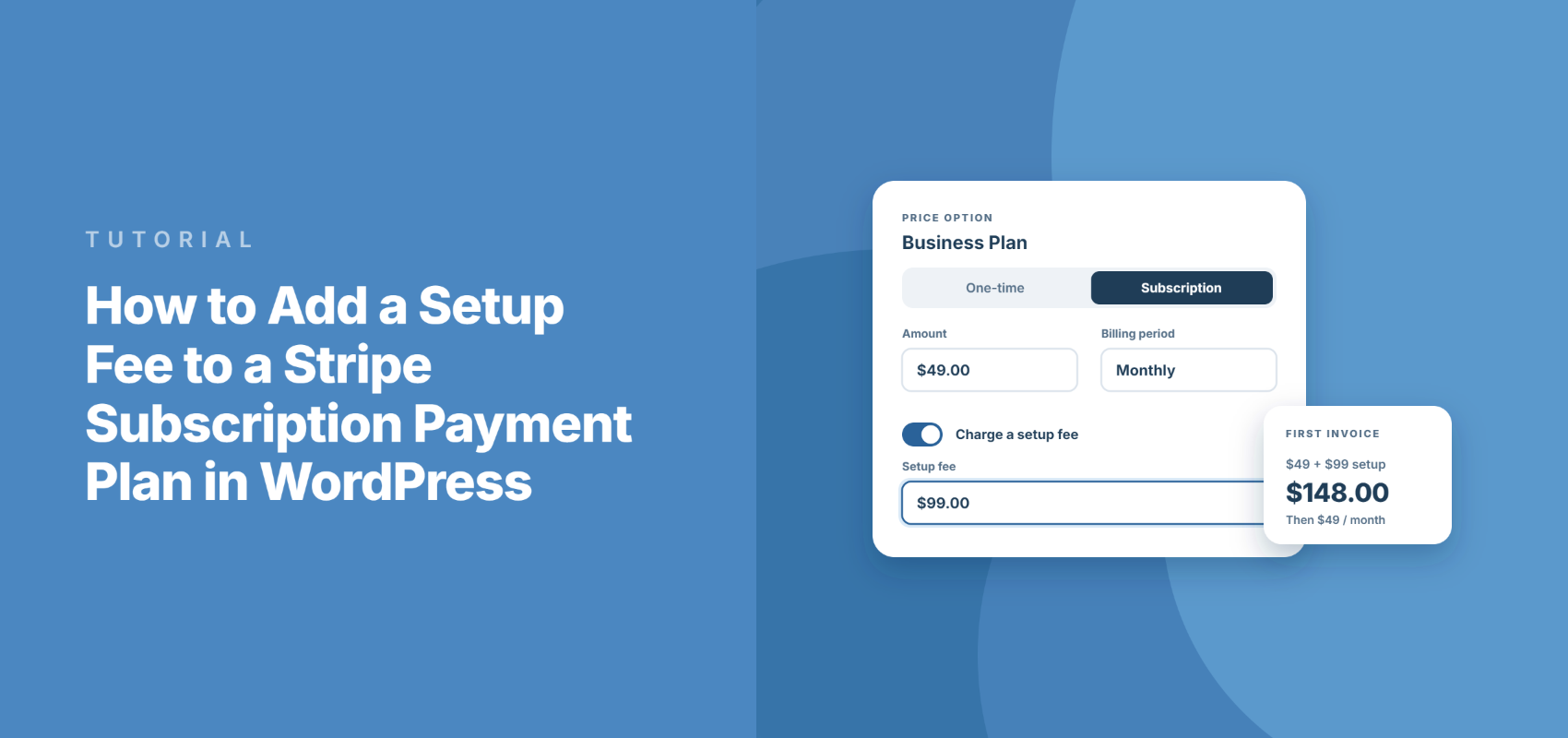
How to Add a Setup Fee to a Stripe Subscription Payment Plan in WordPress
Last updated on

 Spencer Finnell
A subscription setup fee lets you get paid for the work you do before a new client’s monthly plan really gets going. That might be cleaning up their books, building their website, or running a first coaching session.
With WP Simple Pay, the fee is a single field on your subscription price. Your customer pays it once, together with their first payment, and every payment after that is the regular subscription price.
In this article, I’ll show you how to add a setup fee to your subscription payment forms, make sure customers can see it before they pay, and explain how it works with free trials, coupons, and tax.
When Is a Setup Fee Worth Charging?
A setup fee makes sense when you do real, one-time work before the subscription starts paying for itself.
Think of a bookkeeper who has to sort out a new client’s accounts, an agency that builds a site before the monthly care plan begins, or a coach who runs an intake session.
In each case, the setup fee pays for that first stretch of work, and the monthly price covers the ongoing service.
It can also discourage people who sign up on impulse and cancel after a month. When someone has already paid to get started, they have a reason to stick around.
On the other hand, a setup fee is a harder sell when there’s nothing to set up, like a content membership or a newsletter. In those cases, it mostly adds friction, and a competitor without one will look cheaper.
Why Use WP Simple Pay to Charge a Setup Fee?
The way I recommend adding a setup fee to a subscription in WordPress is with WP Simple Pay, a Stripe payments plugin used by more than 14,000 customers.
You don’t need a shopping cart, a membership plugin, or any code. You build a payment form, set your price and setup fee, and add the form to any page.
Here are a few of the features that make it a good fit for subscription services:
- Connect with Stripe in a few clicks. You sign in to Stripe from the setup wizard, so there are no API keys to copy and paste.
- 89 ready-made form templates. These include two templates built for setup fees, so you don’t have to start from a blank form.
- One-time and recurring payments. On the Professional plan, subscriptions can also have free trials, setup fees, and installment plans.
- 10+ Stripe payment methods. Besides credit and debit cards, customers can pay with options like ACH Direct Debit, SEPA Direct Debit, iDEAL, and Cash App.
- Coupon codes. You can offer launch discounts and promotions right on the form.
- No extra plugin fees on paid plans. Stripe’s standard processing fee still applies, but WP Simple Pay Pro doesn’t add a fee of its own on top.
With that covered, I’ll walk you through setting up your first subscription form with a setup fee.
Step 1: Install and Activate WP Simple Pay
To add a setup fee, you’ll need the WP Simple Pay Professional or Elite plan, because the Setup Fee field is part of the advanced subscription features.
You’ll also need a Stripe account. Don’t worry if you don’t have one yet, since you can create it during setup.
Once you have your plan, go ahead and install and activate the plugin on your site. If you need a hand with that, here’s the WP Simple Pay installation guide.
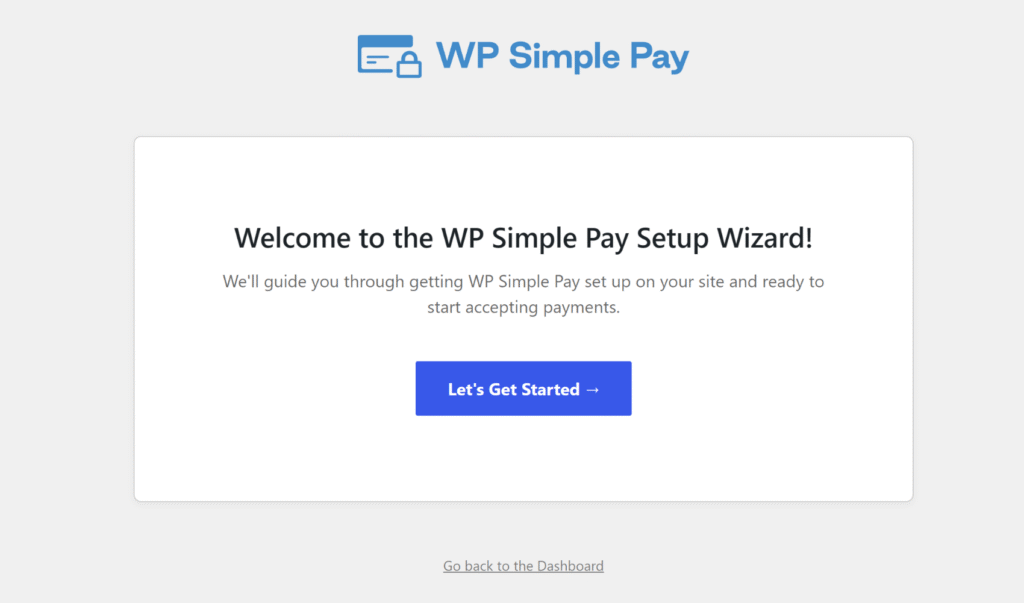
The setup wizard opens as soon as the plugin is active. When you click Let’s Get Started, it walks you through Activate Your License, Connect to Stripe, and Configure Emails.
Step 2: Connect WordPress to Stripe
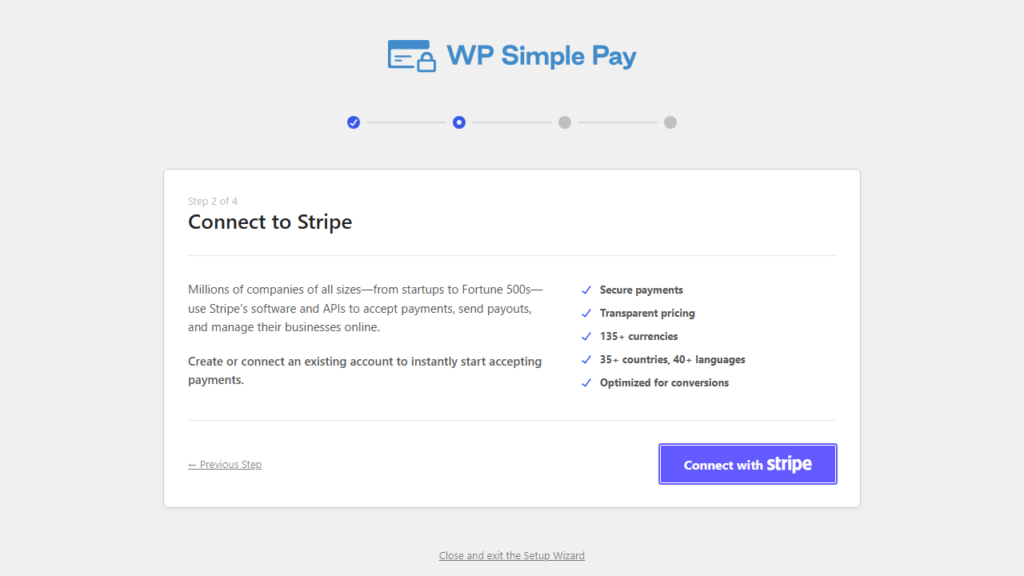
Next, you’ll reach the Connect to Stripe step. Go ahead and click Connect with Stripe, then sign in to your Stripe account or create a new one.
Once Stripe sends you back to WordPress, finish the email step, and you’ll land on the 🎉 Setup Complete screen.
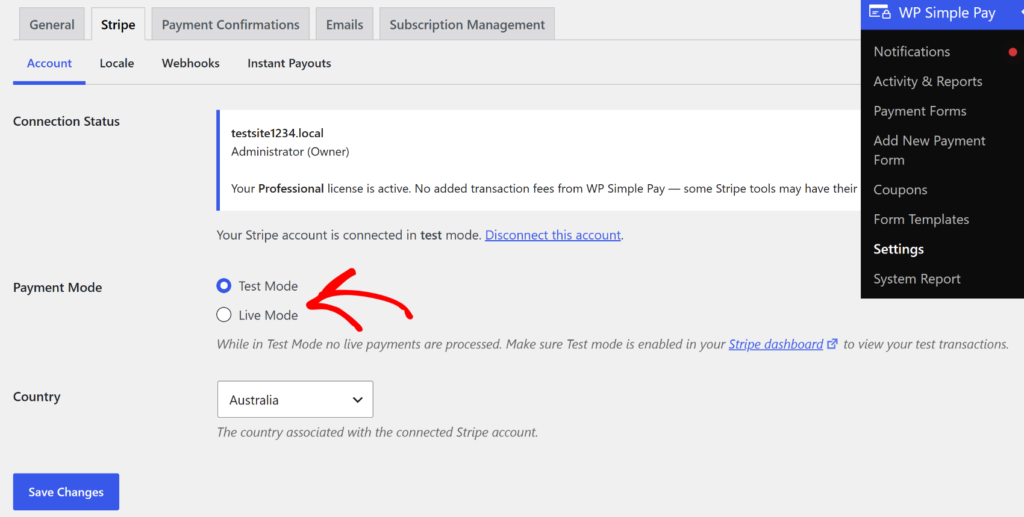
New connections start with Payment Mode set to Test Mode. That’s exactly what you want while you’re building the form, because no real money changes hands.
Step 3: Start From the Subscription Setup Fee Form Template
Now it’s time to create the form. You can click Create a Payment Form on the last wizard screen, or head to WP Simple Pay » Payment Forms and then click the ‘Add New Payment Form’ button.
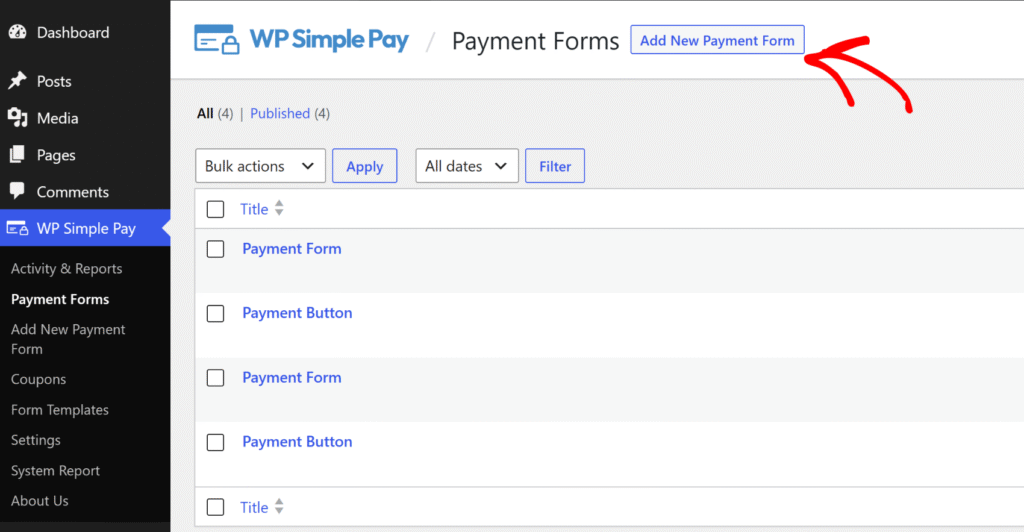
From there, type setup fee into the template search. You’ll see the two templates I mentioned earlier.
I recommend Subscription Setup Fee Form, because it already shows the fee to customers. Simply hover over it and click Use Template.
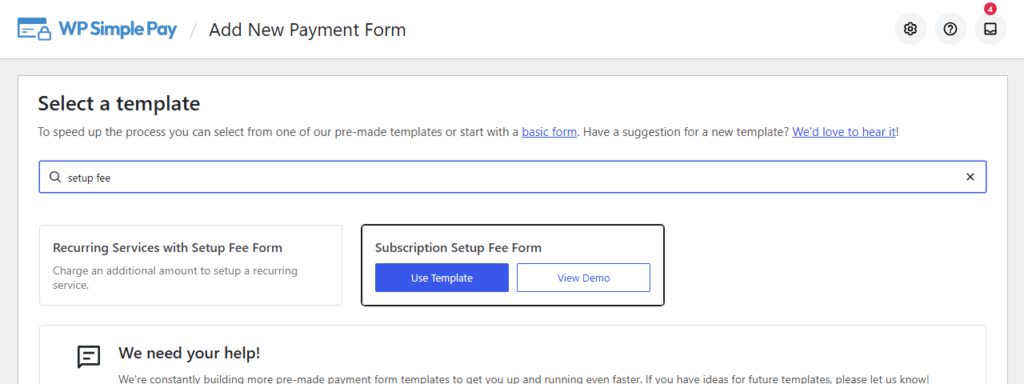
The template comes with a $10.00 monthly price and a $45.00 setup fee. You can change both to match your service in the next step.
Step 4: Set the Subscription Price and Setup Fee
Next, open the Payment tab. On the price option, make sure Subscription is selected.
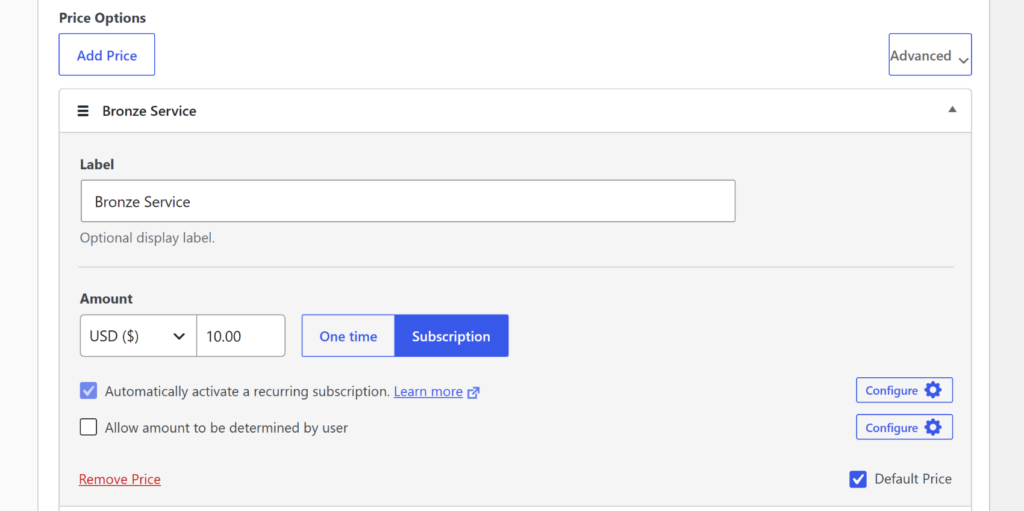
After that, click Configure to open the Recurring Settings dialog.
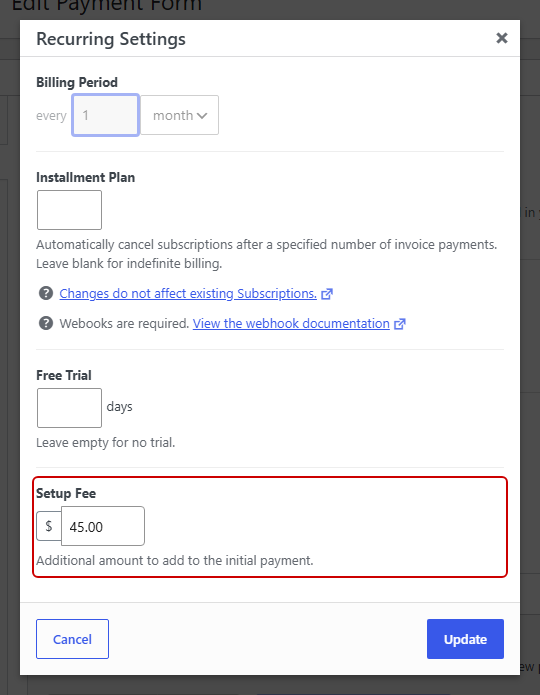
In this dialog, Billing Period controls how often your customer pays the subscription price, like every 1 month.
Below it, Setup Fee is your one-time amount. The plugin describes it as an “additional amount to add to the initial payment,” so it’s charged once and never repeats.
When you’re happy with both, click Update. The price option’s label will now read something like “$10.00 every 1 month with a $45.00 one-time fee,” which is a handy way to double-check your numbers.
Before you save the form, take one more look at the subscription amount, because you can’t edit a price amount once the form is created. The setup fee is more flexible, and you can change it later for new signups.
Step 5: Show the Subscription Setup Fee on the Form
This is the step that keeps your customers from getting a surprise. The Amount Breakdown field is what shows them the fee, and you’ll find it on the Form Fields tab.
Since you started from the Subscription Setup Fee Form template, the field is already there. It shows a “Total due today” line of $55.00, which is the $10 price plus the $45 fee, and a “Recurring amount” line of $10.00 every month.
The payment button says Pay $55.00 too, so the first charge matches what your customer expects.
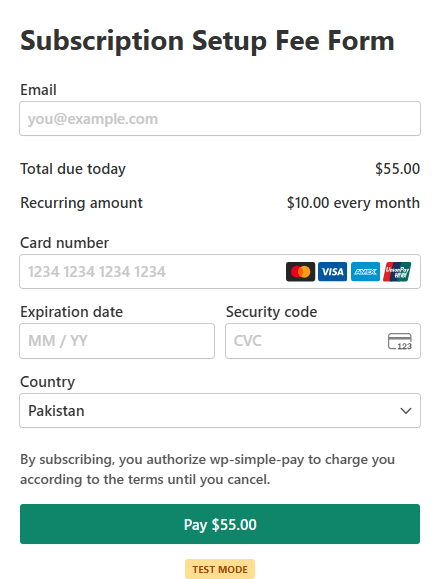
There’s one small gap, though. The breakdown shows $55.00 today and $10.00 after that, but it doesn’t say the difference is a setup fee.
To fill that in, add a short line to the form’s Description on the General tab, like “$45 one-time setup, then $10 a month.” That way, the breakdown shows the numbers and the description explains them.
If you started from a different template or a blank form, you can add the field yourself. On the Form Fields tab, choose Amount Breakdown from the field dropdown and click Add Field. You can rename its lines in the field settings if the defaults don’t fit your offer.
Step 6: Test and Publish the Form
Before you go live, it’s a good idea to run one test signup in Test Mode. Use Stripe’s test card number, 4242 4242 4242 4242, with any future expiry date and any CVC.
Once the test goes through, open the payment in your Stripe Dashboard. The first invoice should have two lines, one for the subscription and one for the setup fee. Every invoice after that only has the subscription.
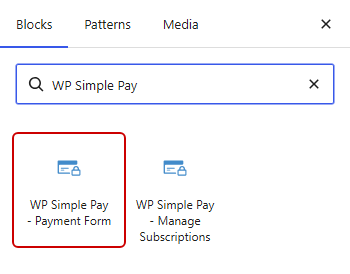
When everything looks right, you can add the form to a page. In the block editor, click the + icon, search for WP Simple Pay – Payment Form, and choose your form.
Finally, switch Payment Mode to Live Mode under WP Simple Pay » Settings » Stripe » Account, and you’re ready to take real signups.
If you’d like a refresher, here’s how Stripe test mode works in WordPress.
How Setup Fees Work With Trials, Coupons, Tax, and Stripe Checkout
Because the setup fee is part of the first invoice, most settings that affect that invoice affect the fee too. Here’s how each one plays out.
Free trials. The setup fee is still charged at signup when the price has a free trial. Your customer pays the fee today and the subscription once the trial ends. If you’re planning a trial, here’s how to add a Stripe free trial subscription in WordPress.
Coupons. A coupon applies to the setup fee as well as the subscription. So a 20% coupon also takes 20% off the fee, because WP Simple Pay doesn’t limit a coupon to the subscription alone.
Tax. The setup fee is taxed the same way as the subscription, whether you use a fixed tax rate or Stripe’s automatic tax.
Fee Recovery. If you pass Stripe’s processing fee on to customers, the recovered amount on the first payment includes the setup fee.
Stripe Checkout. Setup fees also work on the off-site Stripe Checkout form, where Stripe lists the fee as “Initial Setup Fee.” Keep in mind that Fee Recovery doesn’t work on Checkout forms.
Common Setup Fee Mistakes to Avoid
Most setup fee problems happen when the customer isn’t expecting the charge. Here are the ones to watch for.
- Hiding the fee. If your form doesn’t have the Amount Breakdown field, customers may only find out about the fee from their card statement.
- Calling a trial “free” when it isn’t. With a setup fee, day one costs money, so say it plainly. For example, “14 days free, plus a $25 onboarding fee today.”
- Charging a fee when there’s nothing to set up. Without real onboarding work behind it, the fee can feel like a cash grab.
- Running a launch coupon without checking the fee. A percentage coupon discounts the fee too, so the first payment can drop more than you planned.
Frequently Asked Questions
1. Is a setup fee charged during a free trial?
A setup fee is still charged at signup when the subscription starts with a free trial. Your customer pays the fee on day one and their first subscription payment when the trial ends. That’s why it’s best to describe the offer as “free for 14 days, plus a one-time fee” instead of a fully free trial.
2. Can I change the setup fee after creating the form?
You can change the setup fee at any time from the price option’s Recurring Settings, and the new amount applies to new signups. The subscription price works differently. It can’t be edited once it’s saved, so to change it you remove the price option and add a new one.
3. Does a coupon discount the setup fee?
A coupon in WP Simple Pay applies to the whole first payment, including the setup fee. So a 20% coupon takes 20% off the fee as well as the subscription, because WP Simple Pay doesn’t limit a coupon to the subscription alone.
4. Which WP Simple Pay plan includes setup fees?
Setup fees are included in the WP Simple Pay Professional and Elite plans. Lite and the Personal and Plus plans can still sell subscriptions, only without a setup fee. To add one, you can upgrade to Professional or Elite at any time.
5. What’s the difference between a setup fee and an activation fee?
A setup fee and an activation fee are the same charge in WP Simple Pay. Both are a one-time amount added to the first subscription payment. The plugin calls it Setup Fee, but you can call it an activation, onboarding, or enrollment fee on your sales page, and it works the same way.
Final Thoughts
A setup fee works best when it pays for real onboarding work, and your customer can see it clearly before they pay. With the Amount Breakdown field and a one-line description, it only takes a few minutes to get right.
Once your setup fee form is live, you might also like these guides on how to allow customers to manage subscriptions in WordPress and these tips for free trial offers that convert.
Ready to add a setup fee to your own subscriptions? Setup fees come with the WP Simple Pay Professional and Elite plans, so you can compare WP Simple Pay plans and pricing to get started.
Disclosure: Our content is reader-supported. This means if you click on some of our links, then we may earn a commission. We only recommend products that we believe will add value to our readers.

Leave a Reply